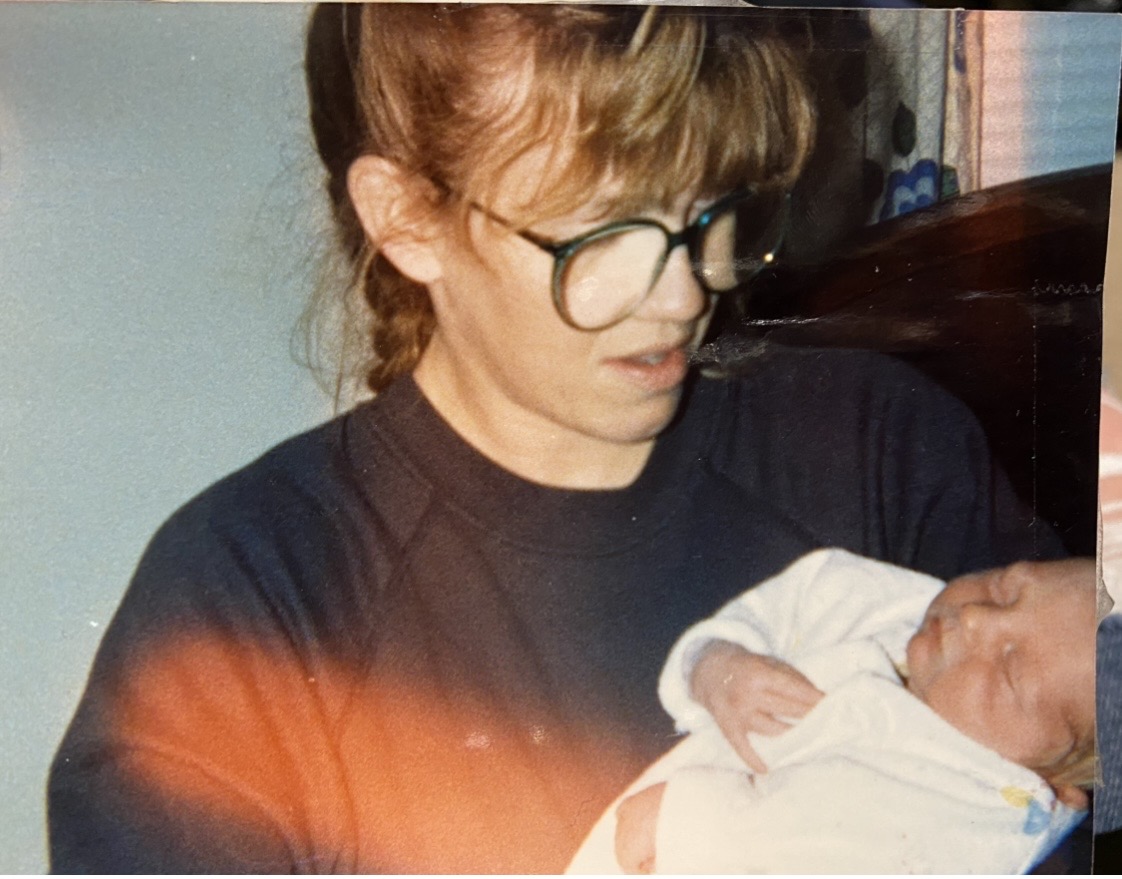
Lies
My mother didn’t just abandon her children—she erased them. For years, my siblings and I were expected to stay quiet while she denied who we were and built a new life. Even after my brother’s death, the lies continued. After decades of protecting everyone else’s version of the story, I’m finally telling my own.
STANDING UP AGAINST THE LIES
Have you ever had your mother lie about your entire existence?
I have.
What’s even harder to understand is that I was taught those lies were necessary to protect her.
All of us were.
Every one of the children she abandoned was expected to keep the story straight. My grandmother made it clear from the time we were little: don’t tell the truth about Shelly. If we did, there would be consequences. There would be drama. There would be a dark cloud hanging over her life.
So we learned to stay quiet.
The strangest part is that the lies didn’t begin after she left us.
They started long before that.
When Shelly was pregnant with my sister Becky, she brought Becky’s father, Dan, to meet our grandmother. Before he met us, she explained who we were.
There would be two little girls there who called her “Mom,” she said.
But she wasn’t really their mother.
According to her story, she had once been married to our father. Our biological mother had died in a car accident. Her mother loved us, and that’s why we called her Mom.
Those two little girls were my sister Stephani and me.
Years later, when she was pregnant with my brother Sam, she told his father the exact same lie.
I remember those visits.
I remember being excited to see her.
Excited to meet these men who would become part of her life.
Excited because my mom was coming.
And all the while, she was introducing me as someone else’s child.
Think about that for a minute.
Not denying me after she left.
Denying me while I was standing right there.
Ten years after she abandoned us, I finally found her living in La Porte City, Iowa.
I thought maybe things would be different.
They weren’t.
She told us we couldn’t tell anyone in her town who we really were because she might lose her children.
Of course, she wasn’t talking about us.
She was talking about Taylor and John.
I remember sitting in her house, staring at a large family portrait hanging on the wall. The three of them were smiling together.
And in that moment, I knew.
I knew she had raised them.
I knew she had loved them.
I knew the excuses she had spent years giving us were exactly what they sounded like: excuses.
And I knew my grandmother would continue helping her protect those lies.
As painful as that realization was, it still wasn’t the worst part.
So let me be absolutely clear.
Shelly Neighbors Willoughby gave birth to my sister Stephani and me.
Shelly Dover gave birth to my sister Becky Dover-Marsh and my brother Sam Tawney.
Shelly Ringlestetter gave birth to Taylor and John Logan.
Shelly Hopkins is all of those women.
One person.
One biological mother.
Six children.
Even after my brother died, she reportedly told Taylor and John that Sam was only their “stepbrother.”
Not their brother.
Their stepbrother.
If someone can erase their own child from the story, how well do any of us really know who they are?
For most of my life, I helped carry these lies because I was taught that telling the truth would hurt other people.
Now I understand something different.
The truth isn’t what caused the damage.
The lies did.
And after decades of protecting everyone else’s version of the story, I have finally decided to tell my own.
The truth about Sam.
The truth about us.
And the truth about Shelly
Postscript:
Recently, I called my grandmother hoping to talk about Sam’s death and the blog.
Her response was simple:
“I heard you’ve been doing some work on the internet, and I don’t want to get into it.”
Then she hung up.
For a long time, I would have chased that conversation. I would have worried about upsetting people. I would have tried to keep the peace.
Not anymore.
At some point, protecting the people who created the damage becomes another form of helping them hide it.
I’ve spent a lifetime being told what I could and couldn’t say.
Those days are over.
The truth deserves a voice too.
The Bad Guys
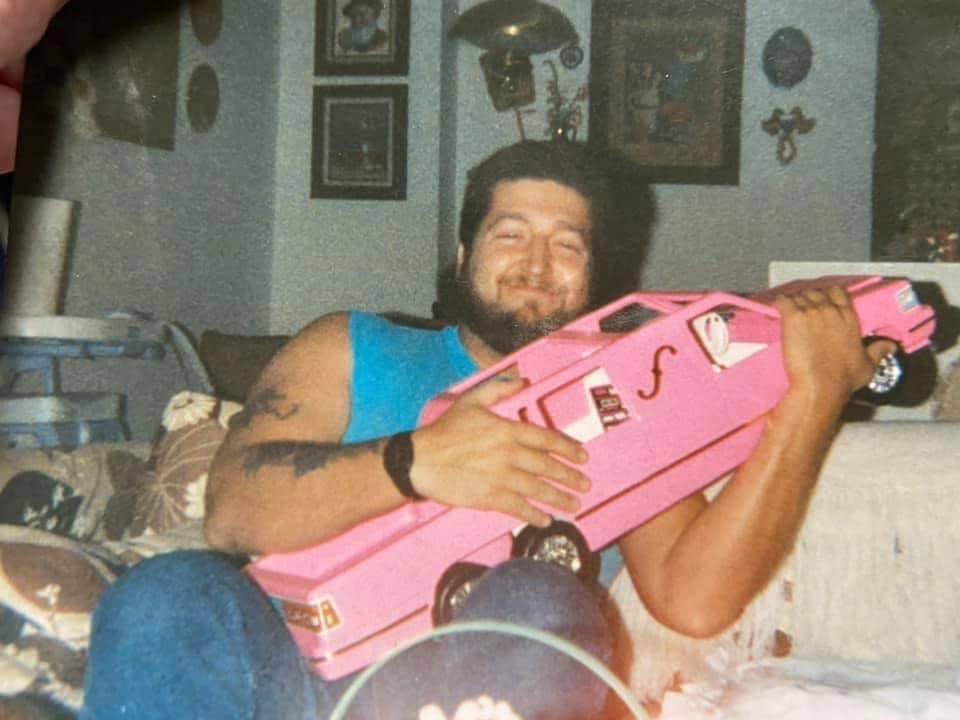
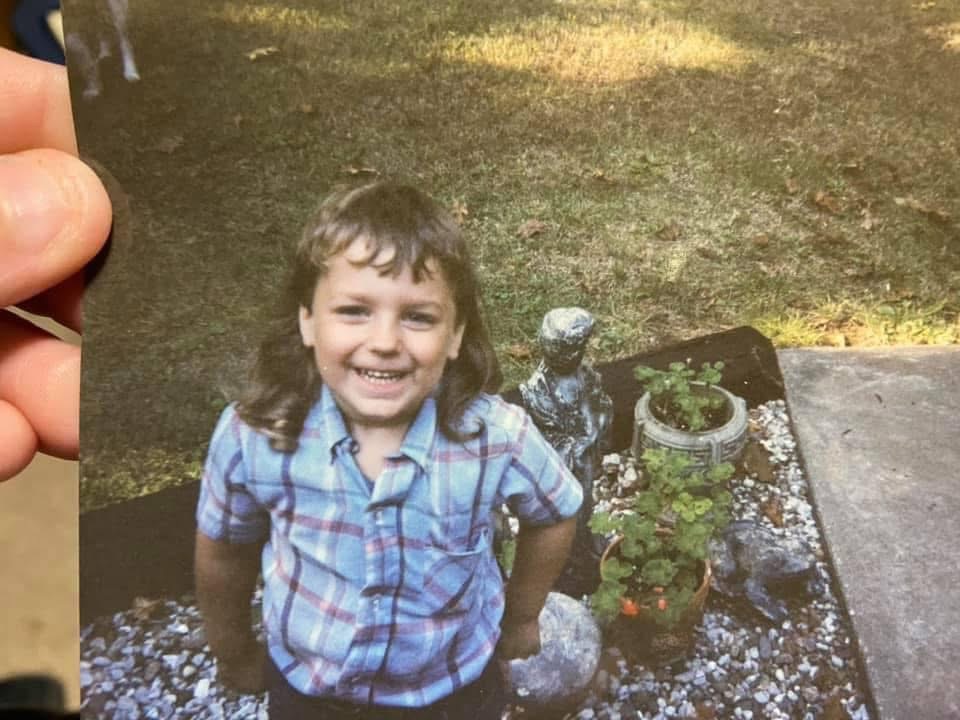
THE BAD GUYS
I remember that day in Bowling Green.
It was beautiful outside, but inside my grandmother’s house, everyone was nervous.
Laken was coming to visit.
We hadn’t seen him in a long time, and you would think we would have been excited. Instead, we were anxious. My grandmother was pacing. I was worried too.
You see, by that point Mom had been gone for about three years, and Grandma was convinced she knew exactly why.
According to Shelly, she was hiding in Florida with a man named Tony because Laken had threatened to kill her if she ever came back.
That was the story.
And like so many stories before it, Grandma believed it without question.
We were told over and over that Laken was dangerous. That he was violent. That he was a killer.
As children, we believed it.
How could we not?
The adults we trusted told us it was true.
So imagine being Laken.
A man left to help raise a child whose mother had essentially dropped him off and disappeared.
A man carrying responsibilities that were never supposed to be his alone.
And in return, he gets painted as a monster.
A murderer.
The villain in someone else’s story.
The strange thing is, real life never matched the story we were told.
This “dangerous” man checked on me throughout my life.
He wrote to me.
Encouraged me.
Told me to have a good day.
Told me he was proud of me.
He sent Christmas cards with pictures of Sam.
He stayed connected when he didn’t have to.
He loved me when there was absolutely no obligation for him to do so.
And he made sure I knew it.
Meanwhile, where was Shelly?
Just this week, when I called to tell her about Sam’s death, she tried to play the same card she had played for decades.
“Laken is dangerous.”
As if I were still the little girl who believed everything she was told.
As if I were still the child she convinced an entire town was her niece instead of her daughter.
I asked her for one thing.
Just one.
Tell the truth.
Tell Taylor.
Tell John.
Give us a chance to have a relationship that isn’t built on decades of manipulation, half-truths, and outright lies.
She told me she would handle it.
Then John blocked me.
And Taylor told me that Sam was only her stepbrother.
Even after his death, the lie survives.
During that conversation, I told Shelly something I never thought I would say.
“I’ll give you this—you taught us self-preservation.”
And she did.
Just not in the way she intended.
Because self-preservation is exactly why I’m telling the truth now.
For years, I was taught that the bad guys were easy to identify.
They were the people Shelly pointed at.
The people she blamed.
The people she feared.
But life has a funny way of revealing character.
Sometimes the people you’re warned about are the ones who show up.
The ones who stay.
The ones who love you anyway.
And sometimes the people pretending to be the heroes are the ones causing the damage all along.
So maybe Laken was never the bad guy.
Maybe the sister trying to piece together the truth isn’t the bad guy either.
Maybe asking for honesty doesn’t make someone cruel.
Maybe refusing to participate in the lies doesn’t make someone difficult.
Maybe the real question is this:
If everyone else is always the villain in your story, at what point do you start looking at the person telling it?
One thing is certain.
The reason Shelly isn’t talking to any of us isn’t because she’s afraid of us.
It’s because apologies require accountability.
And accountability requires the truth.
Starting Trouble
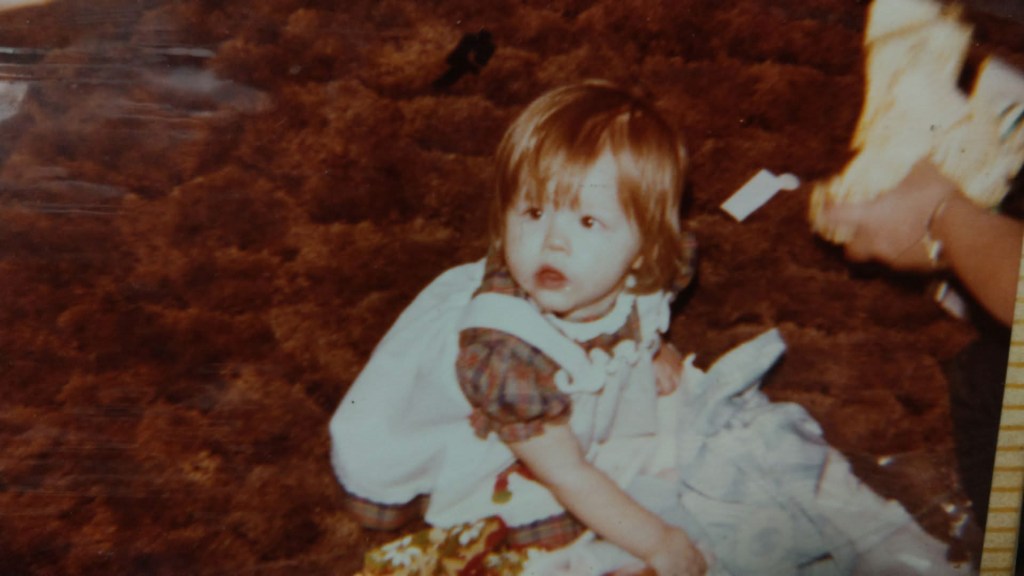
STARTING TROUBLE
“Don’t you girls start any trouble.”
It’s funny how some phrases follow you your entire life.
After I started speaking up a few days ago, other people began speaking up too. Stories started coming out—stories I’d never heard, stories that somehow made perfect sense.
One person told me that when I was little and Shelly was married to my dad, she would wait until he left for work and then lock my sister Stephani and me in a closet so she could go do whatever she wanted to do.
The crazy thing is, I remember the closet.
It had one of those folding doors with slats in it. I remember watching light come through those little openings.
Closet time was nap time.
We were supposed to be quiet.
We weren’t supposed to cause trouble.
As kids, all of us talked about confronting Shelly one day. We imagined that if we could just get everyone in the same room and tell the truth, everything would finally make sense.
Surely the people in her life would want answers.
Surely they would want the truth.
Surely they would see what was happening.
What we didn’t understand then was that some people don’t want the truth.
Not if the lie is easier.
My grandmother and I always had a complicated relationship.
I loved her deeply.
I spent years doing everything I could to help her, support her, and make her happy.
I even drove her to Iowa twice so she could spend time with Shelly.
Twice.
While I sat there being introduced as Shelly’s niece.
Not her daughter.
Her niece.
And somehow, my grandmother’s happiness always seemed more important than my own.
Not just mine.
All of ours.
We had been conditioned to think that way.
One day, Becky heard from our aunt that Shelly and her husband Dave were visiting Grandma Pat.
So Becky and Steph came up with a plan.
Let’s go.
Let’s finally face her.
Let’s tell the truth.
I agreed to go, but I warned them that Grandma and I were already on shaky ground because I had spoken up before.
I couldn’t be the one leading the charge.
They understood.
The whole drive there, we talked about what might happen.
What would Dave say?
What would Grandma say?
What would Shelly do when she was finally forced to acknowledge who we were?
For the first time in our lives, we thought maybe we would get answers.
When we arrived, Grandma met us outside.
She hugged Becky.
She smiled.
Then she looked at all three of us and said:
“Now don’t you girls start any trouble for Shelly.”
Just like that.
Not “How are you?”
Not “I know this has been hard.”
Not “You deserve answers.”
Don’t start trouble for Shelly.
I cannot adequately describe what it felt like to hear those words.
Three daughters standing there.
Three daughters who had spent years trying to understand why their mother abandoned them.
Three daughters who had watched their baby brother grow up carrying the weight of those same lies.
Three daughters who wanted, just once, for someone to choose them.
And before we even stepped inside, we were reminded who mattered most.
Shelly.
As always.
So we went in.
Shelly greeted us warmly.
Hugged us.
Smiled.
Exchanged small talk.
Then she introduced us to her husband.
Becky.
Stephani.
And me.
Just names.
No explanation.
No acknowledgment.
No truth.
Just names.
The room filled with silence.
The kind of silence that only exists when everyone knows something is wrong, but nobody is willing to say it.
We sat there trying not to upset Grandma.
Trying not to start trouble.
Trying to be good girls.
Trying to do what we had been trained to do our entire lives.
Stay quiet.
Protect Shelly.
Swallow the truth.
At one point, Dave looked around the room and finally asked:
“What is going on?”
Silence.
Nobody answered.
Not Shelly.
Not Grandma.
Not us.
And eventually, three daughters got back in a car and drove home.
We cried.
We felt defeated.
And for the first time, I realized something.
We weren’t sitting in a living room that day.
We were back in the closet.
The same closet we had been put in as children.
The only difference was that now Becky was there too.
Once again, the message was clear:
Be quiet.
Don’t cause trouble.
Don’t tell the truth.
And once again, Shelly won.
The performance continued.
The lies survived another day.
I think that day broke something inside Stephani.
I know it changed me.
And I was grateful Sam wasn’t there to witness it.
His heart would have been shattered.
Although, if I’m being honest, I think it already was.
That was how we lived.
Always wondering.
Never knowing.
Always sensing the truth while being told to ignore it.
Always carrying secrets that weren’t ours to carry.
Sometimes I wonder if I should have started trouble that day.
If I should have stood up and said exactly who we were.
If I should have forced the conversation everyone else was too afraid to have.
I try not to stay in that thought too long.
Because regret is a dangerous place.
But I have learned something since then.
Sometimes trouble is just another name for truth.
And sometimes the people demanding your silence are the very people who need the truth the most.
I spent years worrying about becoming the villain in someone else’s story.
What I didn’t realize was that I was already the villain.
The difference now is that I’m no longer willing to stay quiet about it.
Captions
CAPTIONS
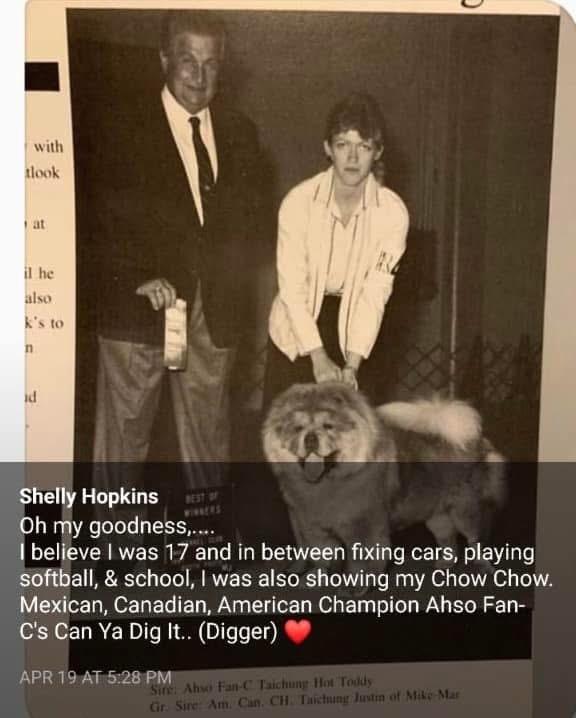
A caption is supposed to be a brief explanation of what you’re seeing in a photograph.
Simple enough.
But when I scroll through Shelly’s social media, I don’t see explanations.
I see revisions.
I see fiction.
I see an entire life carefully edited into the version she wants the world to believe.
The truth is usually sitting just outside the frame.
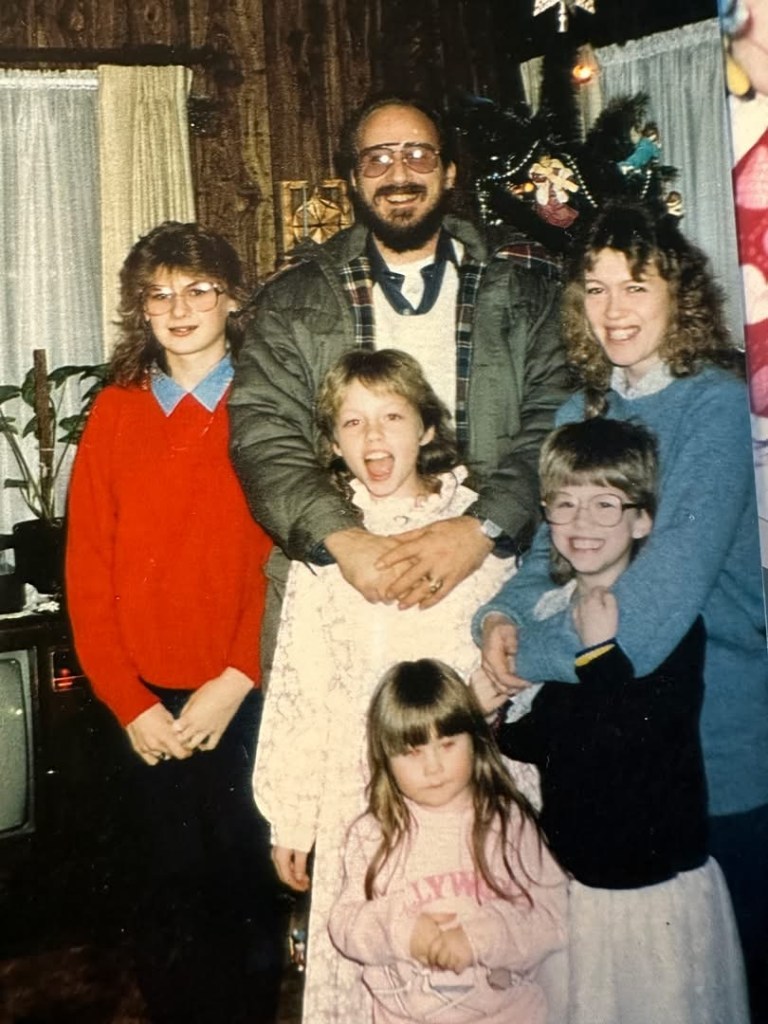
Take one photo in particular.
By the time that picture was taken, Shelly already had three daughters.
Three.
Three little girls who existed whether she acknowledged them or not.
It’s probably around 1987. She’s around 27 years old.
And yet, if you only read the caption, you’d never know those girls existed.
For most people, that would be shocking.
For us, it was normal.
Lies were never unusual where Shelly was concerned.
What always amazed me was how many people seemed willing to accept them.
Maybe they knew.
Maybe they didn’t.
Maybe it was easier not to ask questions.
That’s their choice.
But I’ve seen where those lies lead.
I’ve seen what they did to my brother.
I’ve seen what they almost did to another one.
One thing I’ve learned over the years is that honesty makes liars angry.
Not uncomfortable.
Not defensive.
Angry.
Because the moment someone tells the truth, the entire structure they’ve spent years building starts to shake.
And when that happens, everyone around them feels it.
The liar doubles down.
The stories become bigger.
The denials become louder.
The pressure to stay silent becomes stronger.
And the people who know better are forced to make a choice.
Do they speak up?
Or do they protect the lie?
I imagine my brother and sister in Iowa are feeling that pressure right now.
Maybe they’re angry.
Maybe they’re confused.
Maybe they still believe everything they’ve been told.
Or maybe they know more than they’re willing to admit.
Either way, I hope they eventually decide to find the truth for themselves.
Because our brother never got that chance.
It’s easy to create a version of yourself for the world to see.
It’s easy to write captions.
It’s easy to post photographs.
What’s difficult is maintaining the story when people start asking questions.
That’s usually when the blocking starts.
The distancing.
The accusations.
The punishment for noticing things that don’t add up.
People ask me why I created a website.
Why a blog?
Why now?
The answer is simple.
Because we tried everything else.
Sam tried.
I tried.
My sisters tried.
We reached out.
We asked questions.
We stood face-to-face with her.
We sought conversations.
We asked for honesty.
And every single path led back to the same place:
Denial.
Deflection.
Gaslighting.
Silence.
I have stood inside Shelly’s own home while she lied about who I was.
I’ve watched her introduce me as anything except what I actually am.
Her daughter.
So if private conversations failed, then maybe public truth is the only thing left.
One thing is certain.
The grandchildren are going to ask questions one day.
And if they ask me, they’ll get honest answers.
Not edited answers.
Not caption answers.
The truth.
Yesterday, while talking with Laken after the funeral, I remembered a story I’d almost forgotten.
Shortly after Shelly disappeared in 1993, a dispatcher from the St. Louis area called him.
Her car had been located, but that wasn’t the reason for the call.
The dispatcher had questions.
Shelly had apparently been living with the dispatcher’s son and telling people a story.
According to Shelly, she only had one child.
A son.
And that son had been kidnapped by Laken.
The dispatcher knew something wasn’t right.
So she called.
Laken’s response was simple.
“Sam is right here.”
Within a week, Shelly was gone.
Think about that for a moment.
Imagine learning your mother tells strangers you are her only child while denying the existence of your sisters.
Or imagine being one of the daughters she erased entirely.
Do you know what it feels like to have your own mother deny your existence?
Sam did.
He wanted a mother so badly.
Not a perfect mother.
Just his mother.
He wanted answers.
He wanted understanding.
He wanted to know why she left.
He wanted to know why she didn’t love him enough to stay.
I suspect those questions followed him his entire life.
About ten years ago, Sam sent me a screenshot from Shelly’s social media.
There was a picture of our brother.
Sam couldn’t get over how much they looked alike.
I remember his message.
“Why do you think she’s like this?”
“Why does she hide?”
“Why does she lie?”
I could feel the hurt behind every word.
Then he read the caption.
And he cried.
Not because of the picture.
Because of what the caption represented.
Another story.
Another version of reality.
Another reminder that the truth was always being rewritten.
I didn’t know what to tell him.
I didn’t have answers.
So I said the only thing I could.
“Don’t worry about her captions, Sam.”
“Most of the time there are lies buried in them anyway.”
Looking back now, I wish that answer had been enough. To Sam , this was just another reminder that we were always somewhere outside the frame.
ALIASES
ALIASES
Sam.
Sammy.
Sambo.
Baby Brother.
I called him all of those names at one point or another.
But he was always just Sam.
About ten years ago, after I finally told our siblings in Iowa the truth about who we were, Sam and I were talking about Mom.
At one point he stopped and asked me a simple question:
“What is her last name anyway?”
Think about that.
How disconnected do you have to be from your own mother to not even know what name she’s using?
The truth is, when someone disappears from your life for decades, you don’t even know who you’re looking for anymore.
You don’t know what name they’ll be under.
You don’t know what story they’re telling.
You don’t know which version of them is real.
Sam never stopped searching for her.
Not where she was.
We knew where she was.
He was searching for who she was.
In 2002, Grandma Pat called me on Mom’s birthday.
October 30th.
Not October 31st, as many people have been led to believe.
October 30th.
Coincidentally, it was also Sam’s birthday.
But that’s a story for another day.
Grandma was exhausted.
Broken.
Defeated.
For ten years she had searched for Shelly.
Ten years.
She filed reports.
Contacted authorities.
Followed leads.
Called family members.
Even spent countless hours trying to convince herself that Laken had murdered her.
She recorded conversations.
Contacted law enforcement.
Followed every lead she could find.
And every lead ended the same way.
Nothing.
For ten years she wondered whether Shelly was dead or alive.
Whether she had been harmed.
Whether she would ever see her again.
That night she finally told me she couldn’t do it anymore.
She was giving it to God.
If we were meant to find Shelly, God would lead us there.
I don’t think Grandma realized how deeply those words would affect me.
My faith has always been important to me.
I accepted Christ when I was eight years old.
I grew up surrounded by people who taught me to trust Him.
So when Grandma said she was giving it to God, I listened.
And I acted.
Within forty-eight hours, I found Shelly.
Forty-eight hours.
After ten years of searching.
I was standing on her front porch in La Porte City, Iowa, staring at a pair of tiny shoes by the door and realizing I had found her.
The search itself wasn’t complicated.
I had one piece of information most people didn’t.
Her Social Security number was on my birth certificate.
I ran a basic background search.
And what came back stunned me.
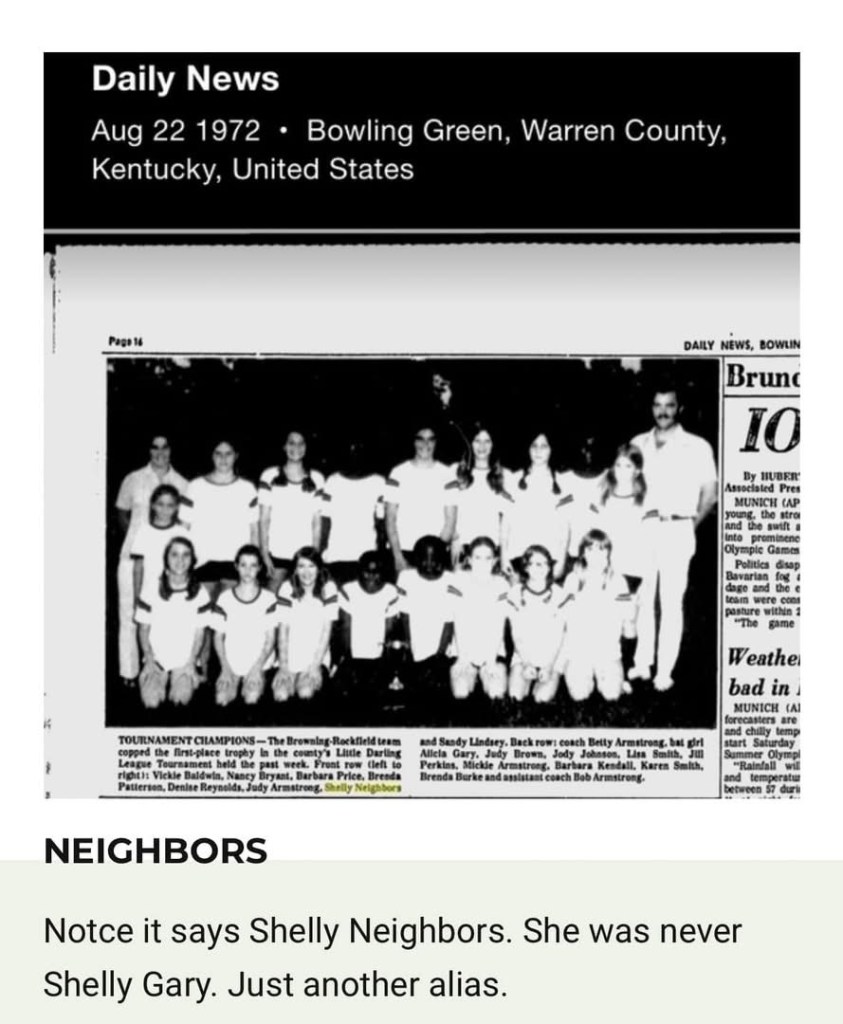
Nine aliases.
Nine.
Former married names.
Names I recognized.
Names I didn’t.
Variations of middle names.
Combinations that made no sense.
Nine different versions of the same person.
And I remember thinking:
How does someone spend an entire lifetime becoming someone else?
How many stories do you have to tell?
How many versions of yourself do you have to create?
At what point do you forget who you really are?
If someone lies about who they are often enough, how can anyone know what to believe?
Those questions stayed with me.
They stayed with Sam too.
Because every time he got close to understanding who our mother was, another version appeared.
Another story.
Another explanation.
Another rejection.
What the people around her now may not understand is that manipulation didn’t begin with us.
Her father was much the same way.
In many ways, she became a reflection of him.
She told me stories about the things he did to her.
Some of them were heartbreaking.
And yet even while telling those stories, she was lying to me.
I know that now.
I knew it then.
She didn’t realize I knew.
Grandma didn’t realize I knew.
But I sat in that living room in Iowa and listened to lie after lie anyway.
Because that’s what manipulators do.
They study people.
They tell them whatever story gets the reaction they want.
And when one story stops working, they create another.
Those are the conversations I would have with Sam.
He would ask why she kept rejecting him.
Why she blocked him.
Why she ignored him.
Why she never seemed interested in knowing him.
And I never had a good answer.
Because there is no good answer.
For more than thirty years, my brother lived without a mother.
Not because he didn’t want one.
Not because he didn’t try.
But because every road led back to another lie.
Meanwhile, the world saw a completely different story.
A respected citizen.
A community member.
A woman featured in newspapers.
A woman celebrated for helping others.
But here’s the irony.
The person everyone was searching for all those years wasn’t some missing woman.
The missing people were her children.
We were the ones left behind.
We were the ones searching.
We were the ones trying to understand.
And Sam searched harder than any of us.
My brother died still wanting to know who his mother really was.
And what’s heartbreaking is that after all those years of searching, all she ever seemed to be to us was an alias.
Return to Sender
RETURN TO SENDER
October 30, 2002.
My grandmother and I had what would become one of the most important conversations of my life.
It was Shelly’s birthday.
Birthdays and Mother’s Day were always the hardest days for me. No matter how much time passed, they carried the same ache.
But this birthday was different.
A few weeks earlier, I had gotten something that would completely change the course of my life.
A computer.
Not one of today’s sleek little laptops. This was a massive Gateway computer with a monitor so big it practically took over my dining room table.
I laugh when I think about it now.
At the time, it felt like the greatest thing I had ever owned.
And in a way, it was.
Because it helped me find my mother.
That night, Grandma Pat called me in tears.
For ten years she had searched for Shelly.
Ten years.
Ten years of phone calls.
Ten years of dead ends.
Ten years of hoping every lead would be the one.
Ten years of wondering if her daughter was dead or alive.
She had called authorities.
Talked to family members.
Followed every rumor.
Even spent countless hours convinced that Laken knew more than he was telling.
Every lead ended the same way.
Nothing.
She was exhausted.
Heartbroken.
And finally, she told me she was done.
“I’ve given it to God,” she said.
“If we’re supposed to find her, He’ll lead us there.”
I don’t think Grandma realized what those words would mean to me.
Because I believed them.
After we hung up, I sat down at my giant computer and did something simple.
I opened the internet.
Back then, I think it was Ask Jeeves.
I typed:
“How do you find a missing person?”
One of the first results was a website called 1-800-US-Search.
Twenty minutes later, for the bargain price of $19.95, I submitted everything I knew.
Less than twenty-four hours later, the results arrived.
Names.
Addresses.
Phone numbers.
Possible criminal records.
And a long list of aliases.
Most of the addresses looked familiar.
Some of the names did too.
Then I saw one that stopped me cold.
Main Street.
La Porte City, Iowa.
I recognized it.
A few years earlier I had mailed a card to an address connected to one of those names.
The card had come back.
Stamped with two words that had become painfully familiar.
Return to Sender.
By then, we had spent years chasing leads.
Every time we thought we had found her, someone would tell us the same things.
“She says her mother is dead.”
“She says she doesn’t have any children.”
Or my personal favorite:
“She said to leave her alone.”
At the time, we were still living under the shadow of all the stories we’d been told.
The stories about Laken.
The stories about danger.
The stories about why Shelly couldn’t come home.
The stories that made us believe she was hiding because she was afraid.
Now I understand something different.
She wasn’t missing.
She was hiding.
There is a difference.
And when I saw that Iowa address, I knew one thing.
If we found her, we had to be careful.
Because I was terrified she would disappear again.
Within hours, Grandma and I were on the road.
Nine hours.
One bathroom stop.
An entire day spent talking about possibilities.
What would we find?
Would she be homeless?
Would she be sick?
Would she be trapped in some terrible situation?
Surely something horrible had happened.
After all, what mother leaves four children behind for ten years?
What mother misses birthdays?
Graduations?
First cars?
Broken hearts?
College degrees?
Surely there had to be a reason.
Because the alternative was too painful to consider.
The alternative was that she simply chose to leave.
When we finally arrived in La Porte City, the sun was beginning to set.
I remember everything.
The quiet streets.
The brick buildings.
The cold November air.
The address.
The house.
A large two-story home.
Not abandoned.
Not falling apart.
Not a crack house.
Not a tragedy.
A home.
There was no car in the driveway.
But there were tiny shoes by the front door.
A snow shovel leaning nearby.
Signs of a life.
A normal life.
I stood on that porch staring at those little shoes and felt it deep in my bones.
We found her.
After ten years.
We found her.
I knocked.
No answer.
Nobody was home.
My heart was racing so fast I thought it might explode.
We were going to have to wait until tomorrow.
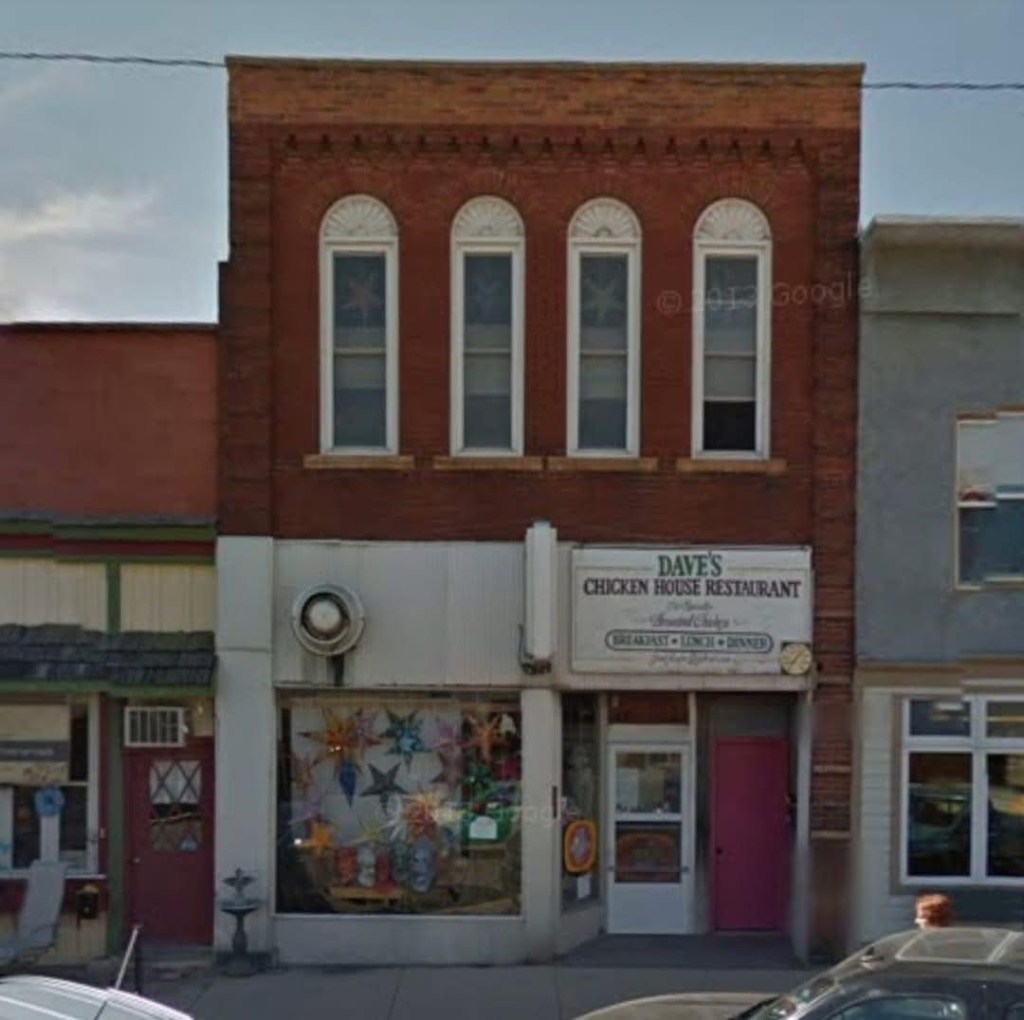
That night we ate at a little place called Dave’s Chicken House.
I studied every face in the restaurant.
Every woman who walked through the door.
Every laugh.
Every voice.
Could that be her?
Could that be my mom?
I barely slept that night.
How could I?
For ten years I had imagined this moment.
I couldn’t wait to hear her voice.
To hug her.
To tell her about everything she had missed.
I wanted to tell her about school.
About life.
About all the things a daughter wants to tell her mother.
Ten years of grief.
Ten years of questions.
Ten years of tears.
I thought they were finally coming to an end.
I thought the next morning would heal something inside me.
I was wrong.
Because as you know now, that day in November ended exactly like all those cards I had mailed over the years.
Exactly like every hope I had carefully folded into an envelope and sent into the world.
Exactly like every attempt to reach her.
Returned.
Unopened.
Unwanted.
Just another reminder of the same message I had been receiving for years.
Return to Sender.
Dead Bodies
DEAD BODIES
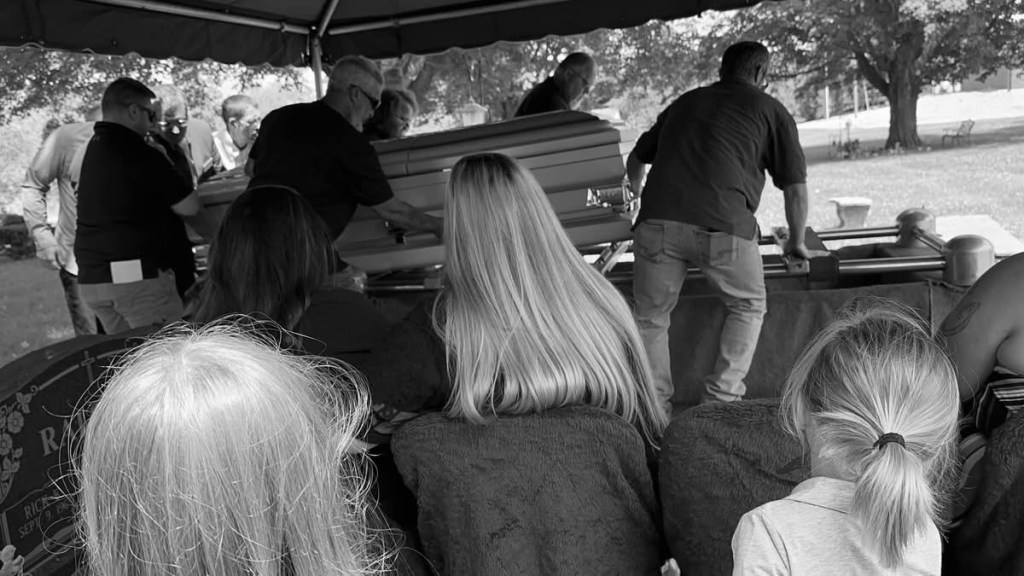
Of all the entries I’ve written so far, this is the hardest one.
No child should grow up hearing that their mother’s dental records have been pulled again because authorities found another unidentified body.
No teenager should spend years wondering if the next phone call will confirm that their mother is dead.
No child should have to live in a world where every body found near a river, every unidentified woman, every Jane Doe becomes a possibility.
But that was my life.
That was our life.
For years, Grandma Pat searched for Shelly.
Every lead mattered.
Every rumor mattered.
Every phone call mattered.
And every time an unidentified body surfaced somewhere, there was a chance it could be her.
I cannot imagine putting my own child through that.
I cannot imagine allowing my daughter to spend years wondering if I was dead while I was alive somewhere else, building another life.
But that’s exactly what happened to us.
The morning we pulled into the driveway at 110 W. Main Street in La Porte City, Iowa, I was exhausted from the nine-hour drive the day before.
But I was also hopeful.
More hopeful than I had been in years.
I had convinced myself that there had to be a reason.
A real reason.
A reason big enough to explain ten years of silence.
Ten years of birthdays missed.
Ten years of unanswered questions.
Ten years without a mother.
Tucked under my arm was a scrapbook.
I had spent weeks putting it together.
Every page represented a piece of life she had missed.
Pictures of Stephani.
Pictures of Becky.
Pictures of Sam.
Pictures of Joey and Autumn, her first grandchildren.
School pictures.
Prom pictures.
Holiday pictures.
Newspaper clippings.
Scholarships.
Achievements.
Memories.
A decade of life carefully organized into pages.
I wanted her to know us.
I wanted her to see what she had missed.
Mostly, I wanted her to care.
When we pulled into the driveway, there was a black Ford Explorer parked outside.
I remember the soccer mom sticker on the back.
That sticker bothered me more than it should have.
Grandma was too nervous to go to the door.
So I walked up by myself.
I knocked.
And then I saw her.
Walking through the house toward the door.
I can still see it.
I can still feel it.
My heart was racing.
I was crying before she ever opened the door.
Then she said words that I have never forgotten.
“Penny Michelle. My Penny Michelle. I can’t believe you’re here.”
A few moments later, Grandma joined us.
And for the first time in over ten years, my mother hugged me.
For a brief moment, the hurt disappeared.
For a brief moment, everything felt okay.
Then I walked inside.
The first thing I noticed was the daycare.
The cubbies.
The tables.
The chairs.
Children’s things everywhere.
And I remember feeling two completely opposite emotions at the same time.
Excitement.
And shock.
I was studying to become a teacher.
I loved children.
Here was something we had in common.
But at the same time, I couldn’t stop thinking:
The woman who abandoned four children is caring for other people’s children?
The woman who left us behind is driving around with a soccer mom sticker?
Whose soccer mom?
I wasn’t angry yet.
I was confused.
Trying to make sense of something that made no sense.
Then we walked into the living room.
And there it was.
The picture.
The giant family portrait hanging on the wall.
My brother.
My sister.
Shelly.
The girl looked so much like me it hurt.
The same curly hair.
The same features.
The boy looked just like Sam.
The same smile.
The same eyes.
And despite everything, I loved them immediately.
I didn’t know them.
But they were my brother and sister.
Part of me already knew that.
Part of me always would.
We sat down.
And Shelly began talking.
As she always does, she controlled the conversation.
She shared stories.
Explanations.
Reasons.
Excuses.
Laken was dangerous.
Her father was dangerous.
Everyone else was the problem.
Everyone else was responsible.
Everyone else was the reason.
Yet somehow, none of those dangers prevented her from leaving us behind.
She made sure she survived.
She made sure she escaped.
She just didn’t take us with her.
Eventually, I handed her the scrapbook.
The scrapbook I had spent so much time creating.
The scrapbook filled with ten years of our lives.
She flipped through it.
Briefly.
Barely looking.
Then she closed it.
Set it beside her.
And said something that still echoes in my mind twenty years later.
“I remember having you, but it’s like it happened to someone else.”
I don’t know if I’ve ever fully recovered from hearing that.
Because in one sentence, she explained everything.
Not the abandonment.
Not the lies.
Not the years.
But the distance.
The disconnect.
The ability to look at your own child and speak as if they belonged to another life entirely.
As if they belonged to someone else.
The rest of the conversation became a blur.
More stories.
More explanations.
More reasons why we couldn’t tell people who we were.
More reasons why we couldn’t be part of her life.
More reasons why she couldn’t acknowledge us.
And the whole time, I knew she was lying.
I knew because I had already uncovered pieces of the truth.
I knew because I had spoken to people she had lied to.
I knew because the stories never matched.
But I stayed quiet.
Because I was afraid.
Afraid we would lose her again.
Afraid Grandma would lose her again.
Afraid that if I challenged her, she would disappear.
Looking back now, I understand something that breaks my heart.
Sam lived that same fear his entire life.
He kept reaching out.
He kept hoping.
He kept trying.
And over and over, he was ignored, blocked, rejected, or forgotten.
After he died, we found a note on his phone.
One sentence.
One sentence that explained decades of pain.
“If only my mom never left maybe I wouldn’t have abandonment issues.”
I don’t have to explain what abandonment does to a child.
Sam already did.
That sentence says more than I ever could.
Now his children have to grow up without him.
And that reality is devastating.
But there is a difference.
They are mourning someone who loved them.
Someone who wanted them.
Someone who was taken from them.
As I think back to that living room in Iowa, I often picture a battlefield.
My brothers.
My sisters.
My nieces.
My nephews.
Pieces of all of us scattered across the ground.
Wounded by years of lies, rejection, and silence.
And in my mind, Shelly is walking away.
Not looking back.
Not stopping.
Not noticing the damage left behind.
Just walking away from the dead bodies.
At All Costs
AT ALL COSTS
To read all entries in order, visit:
www.thetruthaboutsam.com
While working on my Master’s Degree in Counseling, one of my favorite classes was psychology.
I was fascinated by it.
Criminal psychology.
Forensic psychology.
Clinical psychology.
The study of why people do what they do and how the human mind adapts, survives, and sometimes breaks.
One topic that especially caught my attention was psychopathy and pathological lying.
The lack of empathy.
The lack of remorse.
The ability to justify almost any behavior, regardless of who gets hurt.
People often think the most dangerous lie is the one told to others.
It isn’t.
The most dangerous lie is the one a person tells themselves.
Because once someone believes their own version of reality, there is no limit to what they can justify.
Another concept we studied was denial.
Denial isn’t always weakness.
Sometimes it’s survival.
Sometimes it’s the brain protecting itself from a truth too painful to accept all at once.
Looking back, I think I lived in denial for years after I found Shelly in La Porte City.
I had to.
Because the truth was too painful.
After Grandma and I left Iowa that first time, we drove straight to Indiana to see my sister Becky.
I remember Grandma making one thing very clear before we arrived.
“Don’t tell Becky where Shelly is.”
She was terrified that Becky would tell her father.
Her father might tell Laken.
Laken might tell someone else.
And somehow Shelly would be found.
Even after ten years of searching for her, our responsibility was still the same:
Protect Shelly.
At all costs.
So that’s exactly what we did.
We protected her.
We protected her secrets.
We protected her location.
We protected her story.
Even though none of those things had ever protected us.
I remember arriving at the hotel and seeing Becky’s excitement.
She had no idea what news we were bringing.
She even brought her boyfriend along.
The poor guy had a front-row seat as years of family history came pouring out all at once.
I’ve always worried about Becky.
Of all of us, she spent the most time with Shelly as her mother.
She remembers things I don’t.
She experienced things I didn’t.
And she lost things I never had the chance to lose.
One of those things was Sam.
Long before she should have been carrying that responsibility, Becky helped raise him.
While Shelly slept.
While Shelly was gone.
While Shelly was doing whatever mattered more than being home.
At seven years old, Becky became a caretaker.
A protector.
A second mother.
So when Sam was gone from her life too, that loss ran deeper than most people could ever understand.
Her love for him was enormous.
And her love for Shelly was too.
At least, her love for the version of Shelly she remembered.
The version we all remembered.
I think that’s what kept us stuck for so many years.
We weren’t holding onto who Shelly had become.
We were holding onto who she used to be.
Or maybe who we wished she still was.
The softball-playing mom.
The mom with the IROC-Z.
The mom who laughed.
The mom who braided hair.
The mom who made us feel safe.
The mom who existed before everything fell apart.
We kept chasing that woman.
The problem was, she wasn’t there anymore.
Maybe she hadn’t been for a very long time.
Because eventually, the questions started getting louder.
If someone is truly living in fear, do they stay in one place for years?
Do they get married again?
Twice?
Do they have more children?
Do they start businesses?
Do they build a life?
Do they become active members of a community?
The answers were sitting right in front of me.
I just didn’t want to see them.
Because accepting the truth meant accepting something far more painful than any story I had ever been told.
It meant accepting that Shelly wasn’t missing.
She wasn’t trapped.
She wasn’t running.
She wasn’t waiting for the right time to come home.
She had made a choice.
And that realization did more damage to me than anything that happened during the ten years she was gone.
Years later, I returned to La Porte City with Grandma.
I thought I understood the situation by then.
I was wrong.
Because that’s when the final pieces started falling into place.
I wasn’t looking at a frightened woman.
I wasn’t looking at someone who had no options.
I wasn’t looking at someone trapped by circumstances.
I was looking at a woman who was completely in control of her own narrative.
A woman willing to deny her children.
A woman willing to lie about her daughters.
A woman willing to lie about her son.
A woman willing to maintain those lies regardless of the cost.
And the hardest part is realizing that the cost wasn’t paid by her.
It was paid by us.
By Becky.
By Stephani.
By Sam.
By every grandchild who never got to know the whole story.
By every sibling separated by decades of deception.
By a brother who spent his life wanting answers.
And ultimately, by a brother who died still searching for them.
For years, we protected Shelly at all costs.
What I finally realized was that the cost was us.
Out of Order
OUT OF ORDER
I encourage anyone who has survived abuse—emotional, mental, physical, sexual, psychological, or otherwise—to tell their story.
Ask the hard questions.
I am not embarrassed.
And I have no intention of letting the predator win.
After many instances of my sister and me being left unsupervised and after years of turmoil in their marriage, my father divorced Shelly in 1982. With surprisingly little resistance, he was awarded full custody of us.
Dad continued doing what he had always done.
He worked.
He provided.
He raised us.
A lot of that time, we stayed with my aunt and uncle while he worked swing shift at Big Rivers.
But occasionally, we would visit Shelly.
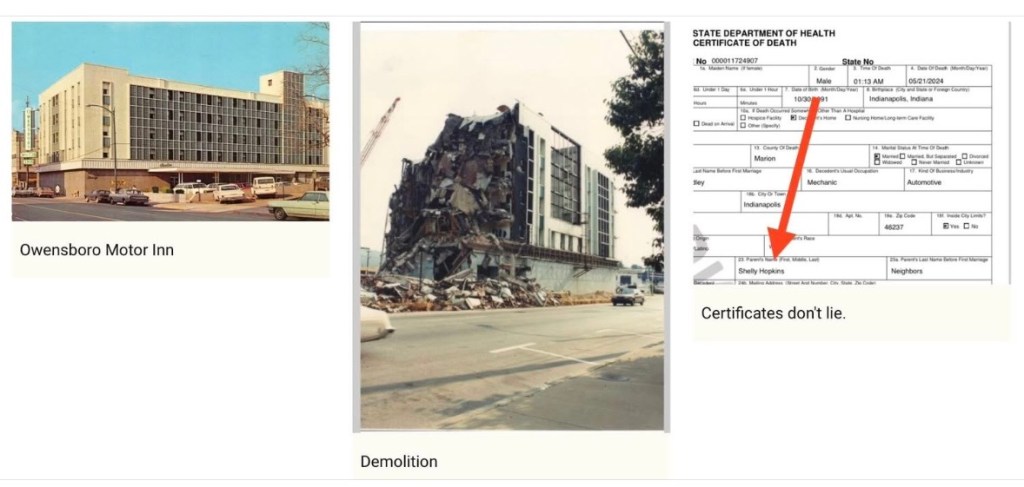
At the time, her father, Shelby, was living at the Owensboro Motor Inn.
By all accounts, Shelly was enjoying her new freedom.
She was young.
She was singing in the bar downstairs.
She was living her life.
I’ve tried over the years to understand that period of her life, but understanding requires answers, and answers are not something Shelly gives.
Ambiguity is her specialty.
I’ve learned that much.
For years, I wondered if my memories of the Motor Inn were even real.
I dreamed about that place long after I left it.
Eventually, I started asking questions.
What I discovered was that I hadn’t imagined any of it.
The memories were real.
I remember the bar.
The cigarette smoke.
The tables.
The stage.
The arcade games lining the hallway.
I remember seeing one machine with a sign hanging from it.
I know now it probably said “Out of Order.”
At the time, I was too little to read it.
Funny how life works.
Years later, those words would describe so much more than an arcade game.
I remember riding the elevator upstairs.
I remember being fascinated by the buttons lighting up.
I remember our room.
A bathroom.
A bed.
A fold-out couch where Stephani and I would sleep.
And I remember the adjoining room.
Shelby’s room.
I remember Shelly kissing us goodnight.
I remember her singing “Hush Little Baby.”
I remember her telling us she loved us.
And I remember her leaving.
Going back downstairs.
Back to the bar.
Back to her life.
Leaving us behind.
Again.
I don’t remember every detail of what happened after that.
Trauma has a way of protecting the mind from things it isn’t ready to carry.
But I remember enough.
Enough to know that any claim that Shelly abandoned us to protect us simply doesn’t fit the facts.
Because if Shelby was truly the monster she later described him to be, why leave us with him?
Why live with him?
Why place your children in his care?
Why walk away knowing he was there?
Those questions deserve answers.
But answers are difficult when someone has spent a lifetime hiding behind ambiguity.
Ambiguity allows people to fill in the blanks themselves.
It creates sympathy.
It creates confusion.
It creates a version of events that can’t easily be challenged.
Maybe she was running.
Maybe she was scared.
Maybe she was trapped.
Maybe she had no choice.
Those are the stories people tell themselves when facts are missing.
But facts matter.
Facts tell a story too.
And facts don’t care about narratives.
The reality is that Shelly repeatedly chose other things over being a mother.
Not once.
Not twice.
Repeatedly.
She had affairs.
She made decisions that hurt her family.
She walked away from responsibilities.
And when questions followed, she rarely answered them.
She simply rearranged the story.
Out of order.
Cause and effect became effect and cause.
Accountability became victimhood.
The children became invisible.
The facts became optional.
That is what makes this so difficult.
Because I know what it is like to survive abuse.
I know what it is like to carry trauma.
I know what it is like to have questions nobody wants to answer.
What I didn’t have was a biological mother willing to protect me from it.
And later, I didn’t have a biological mother willing to acknowledge the damage she caused.
Not to me.
Not to Stephani.
Not to Becky.
Not to Sam.
Especially not to Sam.
Because every unanswered question.
Every rejection.
Every denial.
Every attempt to erase him from the story…
It mattered.
More than anyone wanted to admit.
After Sam died, the facts remained.
The facts don’t change because someone doesn’t like them.
The facts don’t disappear because someone rewrites the story.
The facts don’t depend on memory.
They depend on records.
And state records are not emotional.
They don’t take sides.
They don’t lie.
They show that on October 30, 1991, Sam was born to Shelly Neighbors Dover.
And they show that on May 21, 2024, he died.
Mother listed: Shelly Hopkins.
Maiden name: Neighbors.
No ambiguity.
No aliases.
No rewritten captions.
No story told out of order.
Just the facts.
And facts, unlike people, always remember.
Make Believe

MAKE BELIEVE
Again, I encourage you to speak your truth. Do not be afraid to hurt the feelings of people who had no regard for yours. Speak about what has been done to you. Ask the hard questions while you still can. Do not be quiet. Do not be afraid.
Some of my happiest childhood memories happened during the summers of the late 1980s.
That may surprise people.
After everything I’ve written so far, some may assume every memory involving Shelly is painful.
They aren’t.
That’s what makes all of this so complicated.
After Shelly married Dan, he eventually learned the truth. My sister Stephani and I were not children whose mother had died in a car accident. We were Shelly’s daughters.
Real daughters.
And from what I later learned, Dan made something very clear.
If he and Shelly were going to be together, then she was going to spend time with her children.
So for the first time in our lives, we were invited to spend summers with her in Indianapolis.
I was around eight years old.
And I was thrilled.
For the first time, I wasn’t getting a holiday visit.
I wasn’t getting a quick appearance at Grandma’s house.
I was getting time with my mom.
Real time.
The house on Maynard Drive holds some wonderful memories for me.
Becky and I would spend hours blasting Poison, Mötley Crüe, Warrant, and Henry Lee Summer through the CD changer in the living room.
We would sit outside under the shade trees listening to AC/DC.
We watched The Lost Boys in the basement.
We played restaurant with our toy food stand and served elaborate meals to the adults.
We spent hours creating worlds that existed only in our imaginations.
We lived in make-believe.
Like most children do.
I remember Vacation Bible School at Lynhurst Baptist Church.
I remember watching softball games.
I remember watching Shelly play.
For a little while, I felt normal.
Like maybe I had finally gotten what I had wanted all along.
A mother.
But even then, there were cracks in the picture.
I remember one summer when we still had weeks left before we were supposed to go home.
I overheard Shelly on the phone telling my parents we needed to leave early.
I was devastated.
I remember being so upset that I was beating my head against the wall.
I remember her telling me to stop.
At the time, I didn’t understand.
Now I do.
Because she couldn’t handle it.
Most days she was gone.
Working at the mall.
Working somewhere else.
At the gym.
Out doing whatever she wanted to do.
The reality was that she wasn’t interested in being a full-time mother.
Not to us.
Not even when given the opportunity.
And that realization hurts.
Because those summers meant everything to me.
My last summer on Maynard Drive was 1990.
Years later, I learned things I never knew at the time.
I learned about the affairs.
The pregnancies.
The choices.
The lies.
The divorce from Dan.
And then, in October of 1991, my brother Sam was born.
What shocked me most wasn’t the failed marriages.
It wasn’t the affairs.
It wasn’t even the pregnancies.
It was discovering that she had lied about us from the very beginning.
When Dan first met us, she told him the same story.
The story that our mother had died in a car accident.
The story that she wasn’t our mother at all.
Later, when she met Laken, she told him the same thing.
The exact same lie.
And suddenly, I began looking at my childhood differently.
Because I realized we had all been living in Shelly’s world of make-believe.
Not the harmless kind children create while playing restaurant in the living room.
A different kind.
A world where reality changed whenever it became inconvenient.
A world where children became nieces.
A world where daughters became strangers.
A world where sons became stepchildren.
A world where the truth was optional.
And the hardest part is realizing that she still lives there.
Even now.
She still lies about who we are.
She still lies about who Sam was.
Because the truth requires accountability.
And accountability requires apology.
It’s easier to tell another story.
It’s easier to blame someone else.
It’s easier to say the people asking questions are damaged.
It’s easier to say they’re traumatized.
It’s easier to make them the problem.
What’s difficult is looking in the mirror.
People who know me know I admit when I’m wrong.
People who know me know I would do almost anything for someone I love.
People who know me know that I tried.
Over and over again.
I tried to have a relationship with her.
I took Grandma back to La Porte City three more times.
Three separate trips.
Three separate reasons.
Three separate disappointments.
I remember one drive in particular.
Grandma looked at me and said:
“Just be prepared. She hasn’t decided who you’re going to be.”
I sat there in silence.
Who am I going to be?
Imagine hearing that.
Imagine having to wonder what role you’ll be assigned in your own mother’s story.
When we arrived, Shelly introduced me to her husband Dave.
And within minutes, I got my answer.
“This is Penny, my niece.”
My niece.
Not my daughter.
Not my child.
My niece.
All those years.
All that distance.
All that longing.
And she was still living in make-believe.
Still creating whatever version of reality worked best for her.
I once overheard someone describe Shelly this way:
“Shelly would rather climb a telephone pole and tell a lie than stand on the ground and tell the truth.”
At the time, I laughed.
Now I think they may have underestimated the situation.
The last time I spoke with Shelly was May 21, 2024.
The day Sam died.
I was the one who told her.
After I gave her the news, she said:
“Oh, I am so sorry for you kids.”
For you kids.
I remember sitting there thinking:
He was your son.
Your son.
And in that moment, I was grateful Sam wasn’t alive to hear it.
Because it would have broken his heart.
Or maybe it wouldn’t have.
Maybe by then it already had.
Before we hung up, she said something else.
“One day soon we’re all going to sit down and talk about this.”
The problem is that it’s too late for Sam.
We’ll never know if one honest conversation could have helped him.
We’ll never know if one apology could have eased his pain.
We’ll never know if one hug from his mother might have changed something.
What I do know is this:
She will never truly know my children.
She will never truly know her grandchildren.
She will never fully know the amazing people her children became.
Because that would require stepping out of the world of make-believe and into reality.
And reality requires accountability.
Maybe that’s why the lies continue.
Maybe it’s easier.
Maybe it’s safer.
Or maybe the make-believe has gone on so long that she no longer knows the difference.
But I do.
And so did Sam.
And the saddest part of all is that while we were growing up pretending in playhouses and make-believe restaurants, the adults around us were creating fantasies of their own.
The difference is that children eventually grow up.
Some adults never do.
Open letter, Apology
OPEN LETTER, APOLOGY
For all entries in order, visit www.thetruthaboutsam.com
In June of 2009, I returned to La Porte City.
Writing about that trip is difficult because by then I was finally beginning to understand something I had spent most of my life avoiding.
I wasn’t looking for my mother anymore.
I was looking for the memory of her.
There is a difference.
My entire childhood, I believed that if we could just find Shelly, everything would somehow fall back into place.
If she was alive, surely there would be a way to get our mom back.
Simple, right?
But nothing about the last thirty-plus years has been simple.
Maybe because I didn’t realize who I was actually searching for.
Or maybe because the woman I was searching for no longer existed.
Every trip to La Porte City pushed that hope a little farther away.
The mother I remembered was larger than life.
She had the biggest hair.
The coolest sunglasses.
An IROC-Z with the T-tops out.
Van Halen blasting through the speakers.
She played softball like she was fearless.
I remember one game where she slid into home plate and tore her leg up from ankle to knee.
I remember helping clean the wound afterward.
I remember her laugh.
I remember her energy.
I remember being proud she was my mom.
I remember helping her when my sister Stephani was attacked by our Chow Chow, Attila.
I remember the screaming.
The blood.
The panic.
The ride to the hospital.
I remember helping hold Steph still.
Those are my memories.
Those are the pieces of her I carried with me.
That’s the mother I thought I was looking for.
So when I found her in 2001 and she looked me in the eye and said,
“I remember having you, but it’s like it happened to someone else,”
something inside me broke.
Because if having me felt like it happened to someone else…
Did all those memories happen to someone else too?
How do you forget your children?
How do you walk away?
I’m a mother.
My children are my world.
I can’t imagine it.
In 2009, Grandma Pat asked if I would take her back to Iowa.
Of course I said yes.
I was excited.
Hope has a funny way of surviving long after it should have died.
The drive was filled with stories about the town festival.
The bar Shelly owned.
The things we would do while we were there.
But woven into every conversation was the same warning.
“Be prepared.”
“We don’t know what she’s going to call you.”
I was almost thirty years old.
And still being warned that my own identity might change depending on what story Shelly needed to tell.
I remember sitting silently wondering:
Why?
Why do I have to lie to strangers?
Why do I have to pretend to be someone I’m not?
Why is the truth always the thing that has to be hidden?
When we arrived, I got out of the car and hugged the woman I had spent my life missing.
The hug felt familiar.
The person did not.
Then she introduced me to her husband Dave.
A genuinely kind man.
And she said:
“This is my niece, Penny.”
My niece.
Not my daughter.
Not my child.
My niece.
Outwardly, I smiled.
Inside, I was devastated.
Not because she called me her niece.
Because she made me a liar.
That’s what hurt.
She put me in a position where I had to choose between honesty and having a relationship with my mother.
She put me in a position where telling the truth felt dangerous.
And I hated it.
I hated lying to people I had just met.
I hated lying to Dave.
I hated lying to Taylor.
I hated lying to John.
I hated pretending.
Every step I took through that house felt wrong.
I remember looking at Taylor and John and wanting desperately to know them.
To know my brother and sister.
To tell them who I was.
To tell them who Sam was.
To tell them we belonged to each other.
But I stayed silent.
Not because I wanted to.
Because I thought silence was the price of admission.
The price of having a mother.
The price of keeping peace.
The price of protecting Grandma’s relationship with her daughter.
After the first night, I stayed at a hotel in Waterloo.
I needed somewhere to escape.
Somewhere nobody could hear me cry.
During the festival, I spent a lot of time working in Shelly’s bar.
I stayed busy.
I stocked coolers.
Helped staff.
Did whatever needed to be done.
One of the bartenders was a woman named Penny.
I liked her immediately.
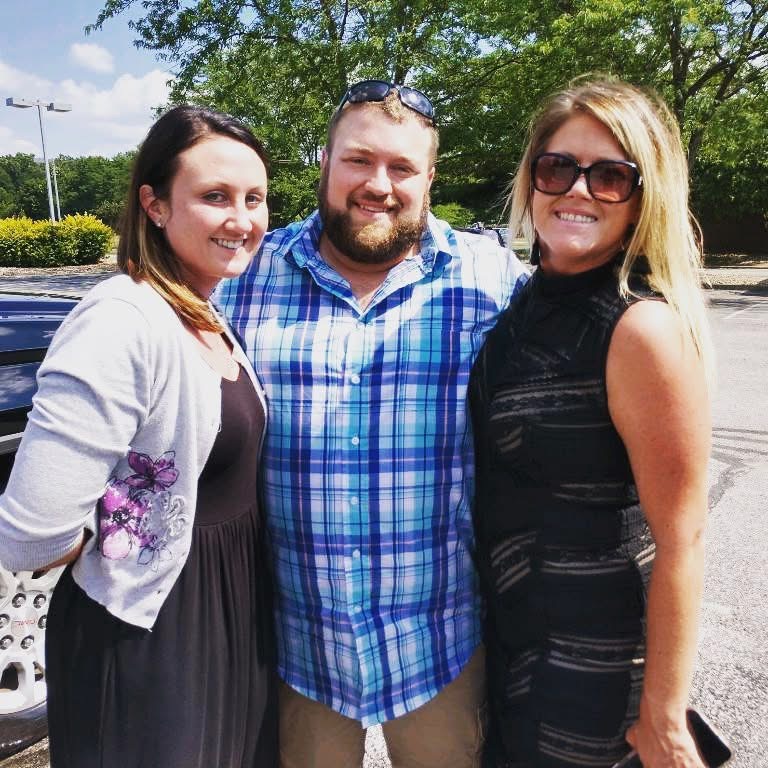
One evening, Taylor stopped by.
Shelly snapped a picture of us together, handed me the camera, and smiled.
“You two look alike.”
Another jab.
Another reminder.
Another truth she was willing to acknowledge only when it was convenient.
Then came the moment I’ll never forget.
On my last night there, the bartender looked directly at me and said:
“You’re not her niece.”
She knew.
I froze.
Every ounce of air left my body.
My mind raced.
I knew exactly what she meant.
And I said nothing.
I lowered my head and walked away.
I’ve thought about that moment for years.
So this is my apology.
To her.
To the people of La Porte City.
To anyone I helped deceive.
I’m sorry.
I’m sorry I participated in a lie.
I’m sorry I allowed someone else’s narrative to become your reality.
I’m sorry I wasn’t brave enough to tell the truth.
I’m sorry Taylor and John never got the chance to know Sam.
You would have loved him.
And he loved you.
The drive home is mostly a blur.
I remember exhaustion.
I remember guilt.
I remember sadness.
I remember asking myself over and over:
Why was this necessary?
Why was protecting the lie always more important than protecting the people hurt by it?
I still don’t have an answer.
What I do know is this:
Being forced to lie changed me.
It created a kind of moral injury that I still carry.
Not because I lied.
Because I knew it was wrong while I was doing it.
It left a scar.
A wound created by betraying my own values to preserve someone else’s illusion.
And that is why this entry exists.
Because there is one thing Shelly has never given us.
An apology.
Not once.
No acknowledgment.
No accountability.
No ownership.
No sincere recognition of the damage she caused.
No change in behavior.
No effort to make things right.
Nothing.
She simply continues living her life as though none of it happened.
But I am not her.
I may have her face.
I may have her voice.
But I AM NOT HER.
I am capable of admitting when I am wrong.
I am capable of accountability.
I am capable of remorse.
And to those who were caught in the middle of a lie I never wanted to tell:
I am sorry.
Truly.
The Last Time
THE LAST TIME
For all entries in order, please visit www.thetruthaboutsam.com
Before I begin, I want to say one thing.
Other people do not get to decide whether you were hurt.
They do not get to decide whether what happened to you was abusive.
They do not get to decide how long you are allowed to grieve.
If something wounded you, then it wounded you.
And you have every right to speak about it.
If the people around you cannot support that, then they are not your people.
Blood has nothing to do with it.
I wish I had learned that a long time ago.
When something happens for the last time, you rarely know it’s the last time.
That’s the cruel part.
There is no warning.
No announcement.
No sign telling you to pay attention because you’ll never experience this moment again.
You just live it.
And then one day, years later, you realize it was the last time.
The last time I spent any significant amount of time with my mother was the summer of 1990.
We were staying with Shelly and Dan at the house on Maynard Drive.
By then, summers there had become familiar.
The swings in the backyard.
The chores.
Running around the neighborhood.
Friends on the street.
Music playing through the house.
For a little while, it felt normal.
Then on July 7, 1990, something incredible happened.
NKOTB was coming to Deer Creek Amphitheater.
And somehow my sister Stephani, our neighbors Laura and Mary, and I were going.
I remember Shelly dropping us off in what felt like the biggest crowd I had ever seen.
Ten-year-old me thought it was the greatest thing in the world.
Looking back, I cannot believe she let us loose in that crowd without adult supervision.
Times really were different.
We had the time of our lives.
At one point we even lost Mary and eventually found her in an area filled with lost children.
Then we piled back into the van and headed home.
I had no idea that summer was ending.
Not because August was coming.
Because something else was.
I remember Shelly sitting on the couch.
She looked different.
Dazed.
Slowed down.
Dan was quiet.
Angry.
Something had happened.
At the time, I didn’t understand.
Years later, I would learn about the affair.
The pregnancy.
The abortion.
And the damage already being done to their marriage.
What I understood as a child was much simpler.
Shelly called my parents and told them Stephani and I needed to come home early.
I cried.
I was devastated.
Why didn’t she want us to stay?
Why was she always willing to let us go?
Why was it so easy?
What I didn’t know was that when I left Maynard Drive that summer, it would be the last time.
The last time I would pet Digger and Molly.
The last time I would walk across those creaky kitchen floors.
The last time I would look out that picture window.
The last time I would leave that house believing there was still time.
If only I had known.
The last time I spent time with my brother was July 28, 2019.
The day of his infant son Zayden’s funeral.
Sam was so happy Becky and I came.
Even in the middle of unimaginable grief, he was excited to see us.
That day I promised him something.
I promised I would try to reach Shelly.
I would tell her about Zayden.
I kept that promise.
I called Dave.
I always felt comfortable speaking to Dave.
He was kind.
Calm.
Grounded.
I told him about us.
About Sam.
About Zayden.
About the grandson Shelly would never know.
He listened.
He said he would pass the information along.
That was the last time I ever spoke to him.
The last time I spoke to Shelly was May 21, 2024.
The day Sam died.
I thought long and hard about what I should do.
I tried calling John.
No answer.
I tried calling Taylor.
No answer.
So I called Shelly.
The woman who had spent decades avoiding difficult conversations was about to receive the hardest one imaginable.
She answered.
“Hello?”
“Hi Shelly, this is Penny from Kentucky. I was calling to let you know that Sam, our Sam, died last night.”
Silence.
Then:
“Oh no. That’s so sad. I’m sorry for you kids.”
For you kids.
Not for me.
Not for him.
Not for herself.
For you kids.
I told her he died by suicide.
She repeated that she was sorry for our loss.
So I reminded her.
“He was your son.”
And her response is something I will never forget.
“I had nothing… I don’t… no… that’s got nothing to do with me.”
Nothing to do with her.
Her son was dead.
And somehow it had nothing to do with her.
The conversation continued.
Excuses.
Deflections.
Promises.
At one point she said:
“One day soon we’re all going to sit down and talk about all this.”
I remember thinking:
Sam won’t.
He’s gone.
The conversation you’ve postponed for decades is too late for him.
Then I asked one thing.
One simple act of mercy.
Tell John and Taylor the truth.
Tell them their brother died.
She agreed.
And for one brief moment, I believed her.
Even after everything.
I still believed her.
That was my mistake.
The last time.
Later that evening Taylor finally responded.
I told her the truth.
That our brother had died.
That he died by suicide.
That I was sorry.
Her response was:
“I didn’t know him. I don’t know what you want me to say.”
Then came the question.
“He was our stepbrother, right?”
Even in death.
Even after everything.
The lie survived.
And in that moment I realized something.
Shelly had succeeded.
Not just in hiding the truth.
But in replacing it.
The last time I spoke to Sam, he asked about Mom.
Again.
He always asked.
Every new phone number.
Every new attempt.
Every new hope.
“Do you have a way to reach her?”
And I always gave him what I had.
Because hope never completely died in him.
Every time he tried.
Every time she ignored him.
Every time she blocked him.
Every time she didn’t respond.
He still tried again.
I asked her about that during our final conversation.
She claimed he never reached out.
She lied.
I know she lied.
Because Sam didn’t.
The last time I spoke to my grandmother was a few days after Sam died.
I called to check on her.
I hadn’t spoken to her in a while.
Her response was cold.
“Oh yes, I know about that.”
Then:
“I hear you’ve been busy on the internet.”
I wasn’t even sure which part she meant.
Facebook?
The blog?
Something else?
I tried to understand.
Instead she said:
“I don’t want to get into it with you.”
And hung up.
Just like that.
I didn’t know it then.
But that was the last time.
Sometimes the last time is obvious.
A funeral.
A goodbye.
A closing chapter.
And sometimes it happens quietly.
A concert.
A summer afternoon.
A phone call.
A text message.
A hug.
A conversation.
You don’t know it’s the last time until it’s already gone.
What hurts the most isn’t that these things ended.
It’s knowing how many opportunities existed to make things right before they did.
And how many people chose not to.
I Believe You, Shelley
Before I begin, I want to say something that may surprise a lot of people.
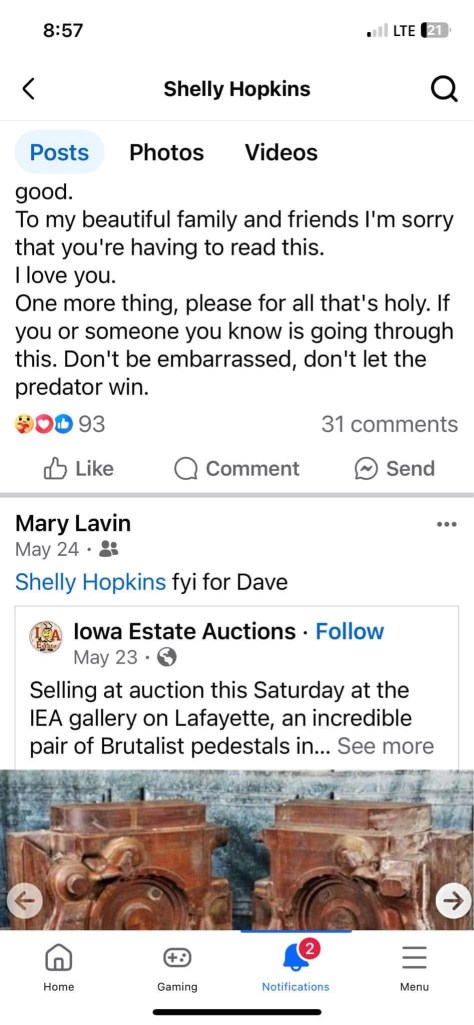
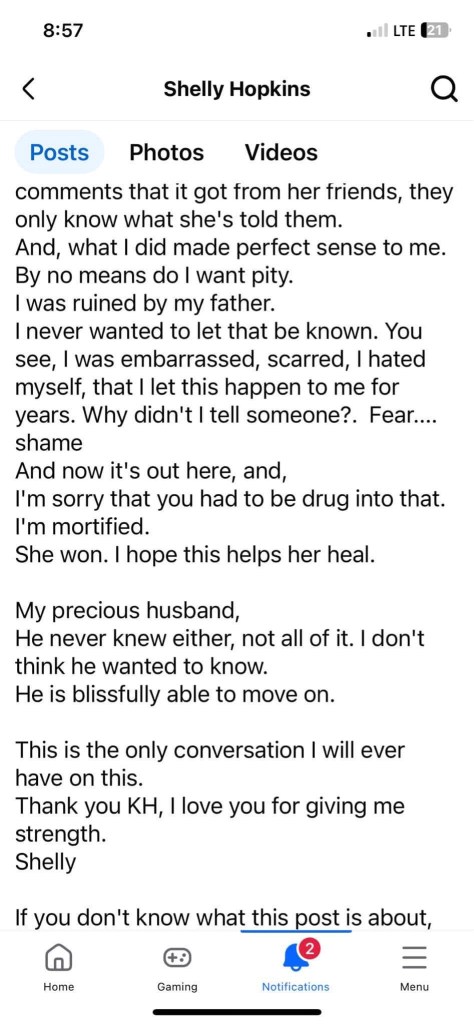
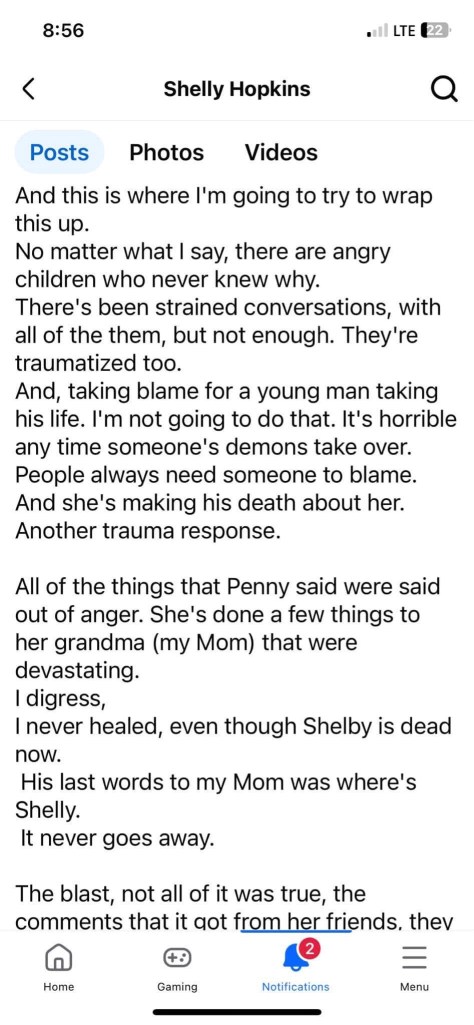
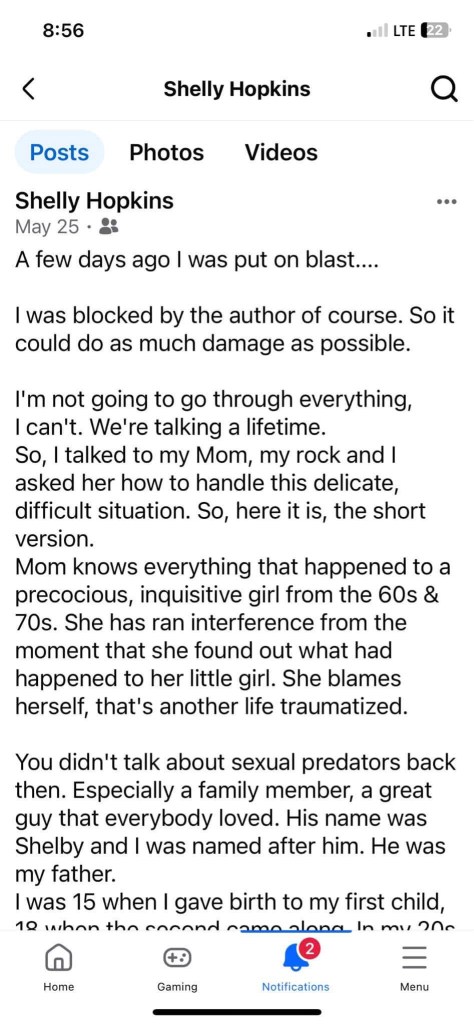
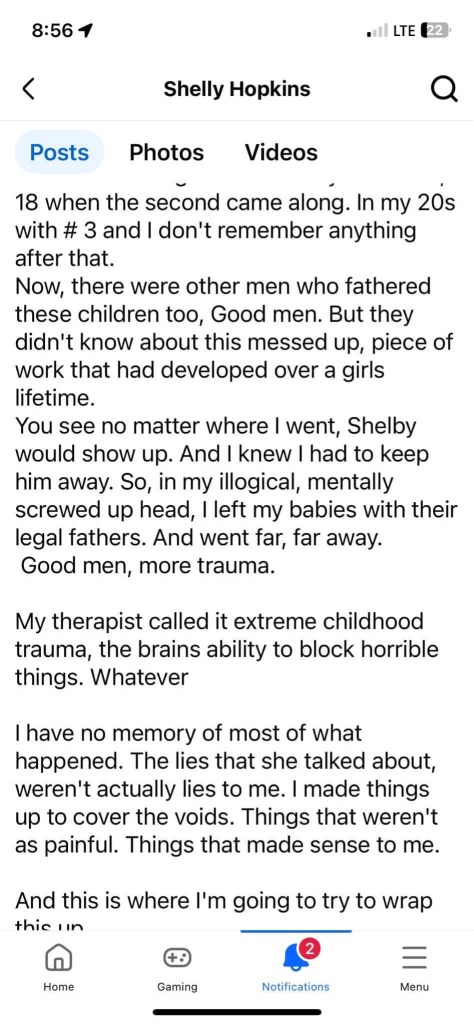
I believe you, Shelley.
I believe terrible things happened to you.
I believe children can be abused and spend the rest of their lives trying to survive the damage that was done to them.
I believe trauma changes people.
I believe it changes the way they think, the way they trust, the way they love, and sometimes the way they cope with life itself.
I believe that because it happened to me.
I know what it is like to carry wounds from childhood into adulthood.
I know what it is like to question your worth because of the choices someone else made.
I know what it is like to spend years trying to make sense of things that should never have happened.
I know what it is like to be hurt by people who were supposed to protect you.
So when you talk about trauma, Shelley, I am not reading your words as a stranger.
I am reading them as someone who understands.
The difference is that much of my trauma came from the choices you made.
Which is why I can believe your pain and still ask you to acknowledge mine.
What I don’t believe is that trauma erases responsibility.
And I don’t believe that one person’s pain cancels out the pain they caused someone else.
Those are two very different things.
Recently, you wrote a public response to my writing.
You talked about your father.
You talked about abuse.
You talked about trauma.
You talked about leaving.
You talked about surviving.
And as I read your words, I realized something.
For the first time in my life, we might actually agree on something.
You said there are angry children who never knew why.
You’re right.
There are.
We are those children.
For decades we didn’t know why.
We didn’t know why our mother disappeared.
We didn’t know why she lied about who we were.
We didn’t know why she introduced us as nieces.
We didn’t know why we had to protect secrets that were never ours to carry.
We didn’t know why we had to accept being hidden.
We didn’t know why we had to pretend.
We didn’t know why.
And maybe you believe you’ve finally answered that question.
Maybe you believe your explanation is enough.
Maybe you believe your trauma explains everything.
But explanations and apologies are not the same thing.
Not even close.
You can explain why you left.
You can explain why you ran.
You can explain why you were scared.
You can explain why you made choices that hurt people.
You can explain why you couldn’t cope.
You can explain why you weren’t ready.
But explanations do not erase consequences.
Four children grew up without their mother.
Four children spent years wondering why they weren’t enough.
Four children learned what it felt like to be denied, hidden, and forgotten.
And one of those children died still looking for answers.
That happened too.
And it matters.
One thing that stood out to me in your post was your statement that you don’t remember much.
Maybe that’s true.
Trauma can do that.
Maybe there are years you genuinely cannot access.
Maybe there are events your brain buried to protect itself.
I am not your therapist.
I am not your doctor.
And I am not trying to argue with your memories.
What I am saying is this:
I remember.
Stephani remembers.
Becky remembers.
Sam remembered.
Our fathers remembered.
Friends remembered.
State records remembered.
Birth certificates remembered.
Death certificates remembered.
The truth exists whether one person remembers it or not.
And that’s where this story has always lived.
Not in memories.
Not in explanations.
Not even in abuse.
The story lives in what happened afterward.
Because while you were surviving your trauma, your children were surviving theirs.
While you were building a new life, we were trying to understand why we weren’t part of it.
While you were explaining your choices, we were living with the consequences of them.
Both things can be true.
You can be a victim.
And so can your children.
The world often acts as if those two things cannot exist together.
They can.
I can have compassion for the little girl who was hurt.
I can grieve for the teenager who was failed by the adults around her.
I can believe your pain.
I can believe your trauma.
And I can still be angry about what happened to us.
Those feelings are not opposites.
They can exist side by side.
So let me say it again.
I believe you, Shelley.
I believe your father hurt you.
I believe trauma followed you into adulthood.
I believe there were days you didn’t know how to cope.
I believe there were days you were overwhelmed.
I believe there were days you were scared.
I believe all of that.
The question is…
Why don’t you believe us?
Why don’t you believe Becky when she says she was hurt?
Why don’t you believe Stephani when she says she was hurt?
Why don’t you believe me when I say I was hurt?
Why didn’t you believe Sam?
Because if trauma explains your actions, then surely it explains some of ours too.
If your childhood pain deserves compassion, then so does the pain your children carried into adulthood.
If you want people to understand what happened to you, then why is it so difficult to understand what happened to us?
Why was your pain always worthy of understanding, but ours was always dismissed as anger?
Why were your explanations allowed, but our questions were not?
Why were we expected to protect your secrets while carrying wounds of our own?
You wrote that people always need someone to blame.
I don’t need someone to blame.
I need someone to acknowledge what happened.
Those are not the same thing.
What I searched for my entire life was never revenge.
It wasn’t punishment.
It wasn’t humiliation.
It wasn’t public embarrassment.
It was something much simpler.
The truth.
And an apology.
Not an explanation.
Not a defense.
Not another story.
Just the truth.
Something as simple as:
“Penny, I abandoned you and I’m sorry.”
“Stephani, I abandoned you and I’m sorry.”
“Becky, I abandoned you and I’m sorry.”
“Sam, I abandoned you and I’m sorry.”
But Sam never got to hear those words.
And that is what breaks my heart.
Because of all of us, he wanted them the most.
I know that because he never stopped asking about you.
Never stopped searching.
Never stopped hoping.
Even as a grown man with children of his own, he still wanted his mother.
The way only a little boy can.
And now he is gone.
I often think about something you wrote.
You said your last words to your mother were asking where Shelley was.
I believe that.
And my heart breaks for you.
Because no child should spend a lifetime looking for their mother.
But Shelley, that’s exactly what happened to Sam too.
And Becky.
And Stephani.
And me.
We spent our lives asking the same question.
Where is our mom?
Not where was she physically.
Where was she emotionally?
Where was she when we needed answers?
Where was she when we needed honesty?
Where was she when we needed accountability?
Where was she when Sam needed her most?
Maybe that is why this hurts so much.
Because for all our differences, maybe we are more alike than either of us wants to admit.
We both spent our lives searching for a mother.
The difference is that yours was still talking to you.
When I read your post, I didn’t feel anger.
I felt sadness.
Because after all these years, we are still having different conversations.
You are explaining.
And I am grieving.
You are defending.
And I am remembering.
You are talking about why you left.
And I am talking about what happened after you did.
Maybe that’s why we’ve never understood each other.
But there is one thing I know for certain.
I refuse to let Sam become a footnote in someone else’s explanation.
He was not collateral damage.
He was not “a young man.”
He was not a mistake.
He was not a stepbrother.
He was not an inconvenience.
He was Samuel Laken Tawney.
He was your son.
He was our brother.
He was a father.
He was loved.
He mattered.
And he deserved better.
We all did. We all DO.
 The Truth About Sam